Tuesday, January 24, 2017

Snowy "Ume" Blossom; Seasonal Sweets Making Class

This is "Ume" plum blossoms that bloom first during the year. Although the flowers were topped with snow in this cold and snowy day, "Ume" tells us the spring is on the way.

My friend's cheek turned red like the color of plum blossoms because she was not accustomed with the cold weather. So we headed to warmer place.


Just before we enjoyed "Ume" blossom, we had been sweet making class that is held in traditional confectionery store located in Higashiyama district. One of the confection that we made was formed into shape of "Ume".


 She is making “Kinton” by using chopstick very well. Green colored mushed paste represents the leave of pine tree. Pine is the part of “Kadomatsu” traditional Japanese decoration of the New Year placed in front of homes. Actually we could see it at the entrance of the confectionery store.


We also stopped by Toyokuni Shrine located nearby the store. Whole shrine was covered with snow. When I visited here last spring, magnificent cherry blossom was bloomed besides the torii gate that you can view in my FB page. Still now they are waiting for upcoming spring.


This shrine is associated with the historical figure of late 16C, Hideyoshi Tyotomi. I have already written about him in the other article.
September 19, 2016 Relics of the tycoon Hideyoshi

Here you can see magnificent gate that is the relic of Hideyoshi’s castle. Nearby the shrine, there is also the relic of Toyotomi family, the historical bell of Hokoji temple.


In the Shintoism shrine, you can find wooden tablet called "Ema" and each shrine has its own shape. Here you can see tablet shaped with his symbol "hyotan" kind of gourd. The other tablet is the shape of "Zori" straw sandal that is related with Hideyoshi's life story.

It was a cold and snowy night, Hideyoshi warmed up straw sandals of his master Nobunag by putting them inside his cloth. Nobunaga appreciated his effort and Hideyoshi successfully showed his loyalty and warmth to his master. Unfortunately I didn’t have warmth to put my friend’s shoes inside cloth as well as Hideyoshi. What I could do for her was to find some warmer and comfortable places.


We also enjoyed Maiko's Dance Performance held at Miyako Messe. It was nice place to avoid the coldness and attract with traditional Japanese culture. Maiko, apprentice of Geiko was wearing ornament and Kimono designed with “Ume” blossoms. Wearing seasonal costume is one of their work. This cold and snowy day, we had enjoyed “Ume” many times in different places.
Maiko Café Art that we enjoyed when we took breakfast at the station.


Sunday, January 22, 2017

Rickshaw and Sukiyaki; Japanese inventions to catch up with the West

 "Sukiyaki" is traditional cuisine consists of thinly sliced beef and vegetables simmered on sauce pan. It was the great among all dishes that I've enjoyed with my Argentine friend. Her country is famous for its large amount of production and consumption of beef. Also Argentine has traditional beef dish called "Asado" that literally means "grilled" or "barbecued" in Spanish. Maybe she would enjoy the different cooking style of beef. That's one of the reason why I had chosen Sukiyaki for the dinner.

 One thing I was concerned about Sukiyaki is that it is served with bowl of raw beaten eggs. After it was well cooked, we picked some pieces of beef and dipped them into the bowl.
How was the verdict?


¡Qué rico!
I'm happy because she really liked it. Actually the mixture of Sukiyaki sauce with beef and raw beaten eggs is melt in your mouth. That also made my face melt like above picture. I have to admit I was so relaxed with enjoying Sukiyaki in traditional Japanese room. Japanese Sake also goes well with Sukiyaki.


This Sukiyaki restaurant uses only soy sauce and sugar as seasoning. As the sugar melt and mixed with soy sauce and oil from beef, it produced the distinct aroma. It gave me the sense of nostalgia that took me back to good old days of Japan.

Sukiyaki was invented in the time when Japan opened its port to the West. That dates back to late 19C. Originally we didn't have the custom to eat meat because of the Buddhist teaching. As western people brought their meat to Japan, people were influenced by their food culture and then Japanese invented own way to enjoy beef dish. That was the origin of Sukiyaki as we know it today.

Not only food but also veichle was also invented in that period. That was Rickshaw, veichle pulled by a man. It is called "jinrikisha" in Japanese, "jin" means human, "riki" means force, and "sha" means vehicle. So it literally means "human-powered vehicle" and the English word "Rickshaw" is derived from Japanese word "rikisha". We tried it when we visited Arashiyama after enjoying Studio Park in Uzumasa.

It was perfect transportation for us to enjoy the views of Arashiyama efficiently. Olden days, Arashiyama was one of the resort for aristocrat to escape from daily life and they trip to there by using Ox-Cart. For Samurai lord or ordinary people in feudal Japan, there was the other human forced transportation “Kago”, kind of palanquin but it took place for rickshaw in late 19C.

Rickshaw was faster than Ox-Cart and “Kago” palanquin and it spread rapidly just after Japan open its door to the West. Maybe Japanese needed faster transportation to catch up with Western civilization. For that purpose, we also needs nutritious food such as meat so “Sukiyaki” was encouraged by cultured people, for example, Yukichi Fukuzawa, the man you can find on ten thousand yen bill  recommended Japanese meat consumption to be stronger. Maybe “Sukiyaki” contributed for Japan to make its military and economy stronger.

Although we spent a "Yukichi" ten thousand yen for the amount of Rickshaw and Sukiyaki, it was worth paying.  We could save and gain out energy by taking rickshaw and eating Sukiyaki for the next day activity!


Thursday, January 19, 2017

Snowy Studio Park

I have an Argentine friend who is studying Japanese in Tokyo. She came to Kyoto on her school days off and we enjoyed snow all around the city!

At first, she'd like to go Universal Studios Japan (USJ) where you can enjoy some attractions of Hollywood movie and modern culture. It is not so bad idea but we had only 2 days and the entrance fee is expensive for us. That's why I suggested her to go Japanese movie theme park located in Uzumasa instead of USJ. Despite of some negative reviews, it was a perfect place for us to experience traditional Japanese culture.

It was a cold and snowy day like above picture...As soon as we got to the theme park, it started snowing. There are a lot of snowy scenes on Japanese movie, for example, the final act of "Forty-seven Ronin (Chūshingura)" takes place on a snowy night.

"226: THE FOUR DAYS OF SNOW AND BLOOD" depicting the coup d'état in Japan 1936 was also taken on snowy day. Both of them are based on historical incidents. Fortunately we couldn’t encounter any revenges and military incidents.


There were some shows and attractions and we avoided heavy snow inside the theater. One of them was “Street Performance Re-Enactment”, an actor played the role of a mysterious oil vendor from the Edo period.


He cut folded paper with oil pasted sword to prove the effect of it. As small pieces of white paper flying, it was like snowing. Olden day, Japanese movie studio used the device of scattering paper to depict snowy scene.


The quarters of the Shinsengumi who policed ancient capital Kyoto. I wrote about the Samurai Show of Shinsengumi held at the Nijo Castle on my blog.


Because of bad weather, we could not take "Samurai Sword Fighting Lesson", but we enjoyed souvenir picture with actors of studio.


Not only historical movie sets but also you can enjoy some funny devices. Suddenly Nessie surfaced off the pool of studio with her screaming sound. Seemed like that Nessie also had enjoyed snowy day.


In spite of additional fee, Trick Art'Museum was also fascinating attraction. We took several funny shot like following pictures.


Saturday, November 5, 2016

Castle witnessed rise and fall of Tokugawa Shogunate

 Today I guided my guest to Nijo Castle and we enjoyed the festival to commemorate the 150th anniversary of “Taisei Hokan”, the return of  the sovereignty to the Emperor by the Tokugawa Shogunate.  If you visit Nijo Castle, you would stroll inside the Ninomaru Palace consists of 33 rooms. One of the biggest room is historical place where the last Tokugawa Shogun  announced the plan to give the power back to the Emperor. 

Taisehokan
This historical picture depicts the moment when the Shougun announced the plan and his follower was listening the shocking announcement. 

You can enjoy virtual walking tour in Nijo Castle from following link.
http://www2.city.kyoto.lg.jp/bunshi/nijojo/nijoujou0930amana-p/nijoujou0930amana-p/tour.html


 Around that time of the end of Tokugawa shogunate, there were a lot of revolutionaries in Kyoto city to change the Samurai regime. To prevent their revolutionary plan, Tokugawa shogunate organized the special police force called "Shinsengumi". In the show we enjoyed today, Vice Commander of "Shinsengumi" defeated some outlaws.

 The show was held in front of Ninomaru palace. Blue uniform wearing man is the role of Hijikata Toshizo,  Vice Commander of "Shinsengumi". 


 They are actors from Toei Kyoto Studio Park. The Japanese swords they are using is well made imitation so even sightseeing people can manage it. 


 Nijo Castle was the symbolic building of Tokugawa Shogunate in Kyoto to show off his power. It had the castle tower but it was burned out because of lightning. You can browse the tower from the following link.
National treasure "The area in and around the Kyoto city (Funaki-version)"

 This folding screen was painted around 1615. It was the time of "Siege of Osaka", Tokugawa Shogunate attacked the castle of his rival Toyotomi. Following historical drama depicting the scene that Tokugawa Ieyasu taking the enemy's former vassal into his side.(Around 0:35) 
"Historical Drama “Sanada Maru”"

Nijo Castle was used not only for military purpose but also for diplomatic purpose by showing off magnificent folding screen paintings.

 Talking back to the folding screen that I showed with link address above,
it is called "rakuchū rakugai-zu" in Japanese and that means  paintings of the area in and around Kyoto city. I really like it, actually my blog title is inspired by the name of the folding screen. And it is interesting to note that "Rakuchū ", inside the Kyoto city was surrounded by rampart wall. 


Odoi landsat.jpg
GFDL, Link


 After visiting Nijo Castle, I guided my guest to the oldest building inside the above former  rampart wall.  The main hall of Senbonshakado was built in 1227. It was almost 800 years ago and the main hall has survived war fire and fire incidents. It also holds interesting "Six Kanon statues" carved in that time and they are designated as National Treasure. I would write about them in other time.

 On the way to back to the hotel, we talked about their next destination "Uji city" famous for green tea production. I told them a well known joke about tea is that "Green tea flows out instead of water when you turn on a faucet in school located in Uji city."
 They also talked me a joke. They have watched a  Japanese anthology horror film "Kwaidan " consists of four separate stories and one of them was "Hoichi the Earless". The thing was my name "Koichi" is similar to "Hoichi" and they were relief to know that I am not "Hoichi the Earless".

Saturday, October 29, 2016

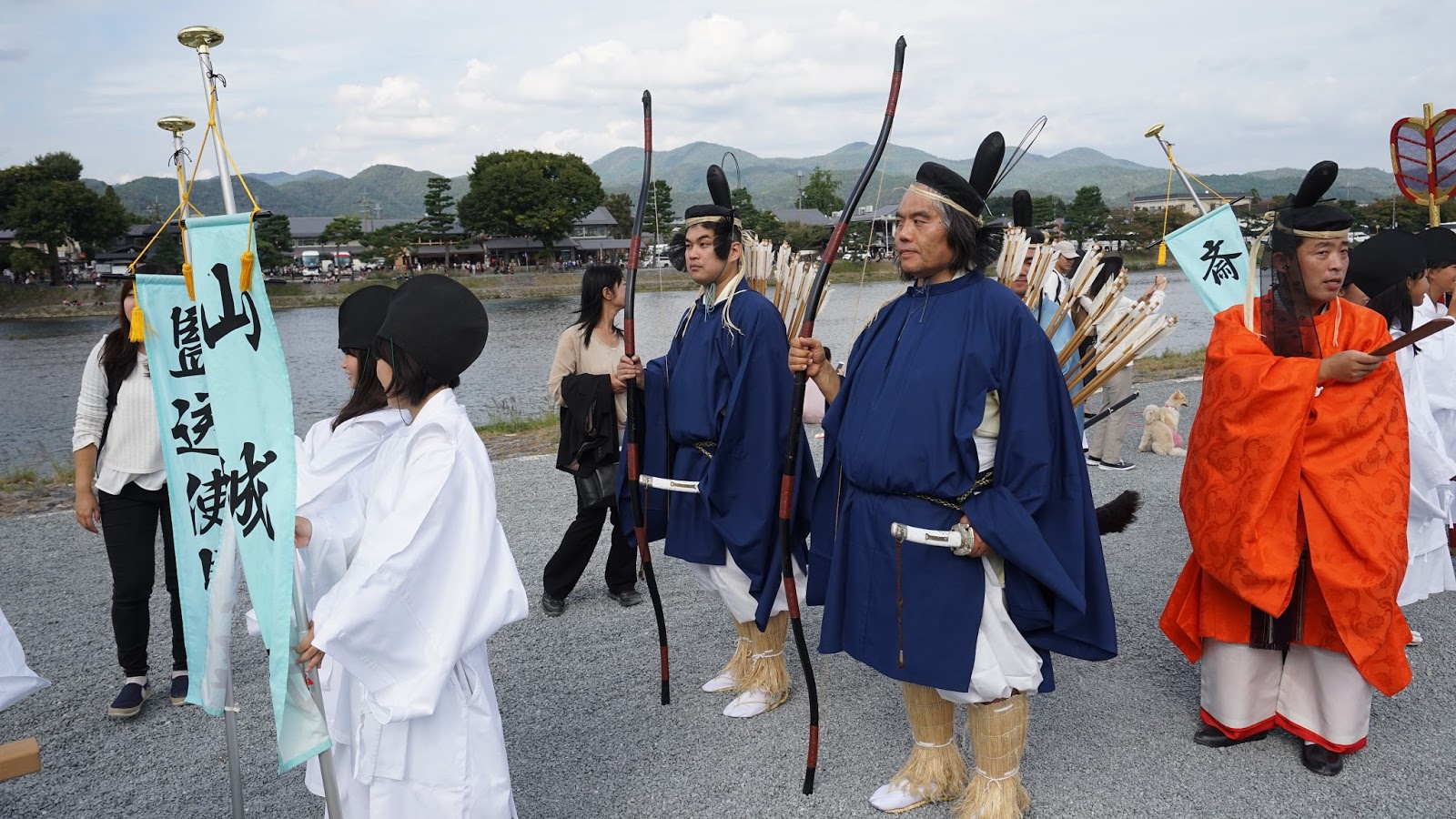
“Saigu Procession” held around Arashiyama Bamboo Grove

 Bamboo forest of Arashiyama is always bustling with people and most of them are from overseas. With so many foreign visitors, some time I feel like walking in the somewhere outside of Japan such as China… There is the one way to escape from such feeling and coming back to Japan in Arashiyama. That is “Saigu Procession”.
On the day of “Saigu Procession” you can enjoy many Japanese wearing traditional clothes. Every year, it is the annual event held third Sunday of October so I went to Arashiya that day with my guest to see the procession.


 The place we enjoyed the procession was located just after crossing the Togetsu-kyo bridge. We could take many photos without bothering traffic. And it was the place where the procession stops and all associates of the procession is supposed to be gathered there and supposed to be taken the group photo. It was the best place to take whole procession with backdrop of the bridge and mountains of Arashiyama.


 Those ancient instruments are associated with Shintoism. It is used for enhancing the power of deities.

 Saigu procession has historical significance and originally it headed to Ise Shrine, the most important Japanese Shintoism shrine located between Kyoto and Tokyo. Even president Obama visited there this May because G8 summit was held in the prefecture of Grand Shrine Ise.

The procession is mainly consisted of locals.

 Talking about the procession consists of people wearing historical costumes, we remind the “Jidaimatsuri” or "Festival of Ages" , its procession starts from the imperial place in Kyoto to Heinan shrine. It is so interesting festival that you can enjoy many traditional costumes but the problem is that it is always clouded with people around the procession. This year, festival of Ages procession was held the next Sunday of Saigu so I expected many people coming to enjoy it. Thet’s why I chose for Saigu procession instead of “Jidaimatsuri”.

After enjoyed the procession, we climbed up to the Monkey Park located in the almost top of the mountain. I took about 20 minutes to get to there but on the way to the destination, my guest could ask me some general questions of Japanese culture such as the local festivals. It was good change escaping from the noisy cities and attract with cute monkeys.


Please be careful, some monkeys would upset to you if you take the photo of them in close distance.

Before the Arashiyama, we visited Nijo Castle located nearby my guest accommodation. On the way to the castle, we stopped in the shrine that has golden tori gate. It is the shrine associated with metals. There were also water purification basin to wash coins. Maybe we can expect the purified coins would attract more of them in your wallet.


 Maybe you would notice that my guest wearing old costume again. Shigureden is the best place to enjoy to experience old aristocrat culture and avoid crowd of people in Arashiyama. 

Monday, October 17, 2016

Memorial service for Dolls held in Hokyoji Temple

Talking about the doll associated festival, Hina-matsuri or Girls' Festival observed on March 3 is well known traditional Japanese event. Each family displays a set of Hina dolls and prays for the healthy development of their girls. But few knows about the doll memorial service and its significance. Every October 14, memorial service for Dolls is held in Hokyoji Temple so I guides my guest there to explain about our traditional culture. There were already a lot of people when we arrived at the temple. Last year I took some photos at the front line so I gave the good view point to my guest. Following is the photos I took last year.
Tayu high ranked geisha attends the memorial service and offer the traditional performing arts. This year also a lot of dolls were gathered there. Among them was stuffed animal such as Pooh. My guest's family has daughters and they cherished stuffed animal but American doesn't have custom to hold memorial service for dolls. The difference comes from Japanese believing that all bad things such as illness and evil spirits will be transferred to them by touching the dolls. So the memorial service is to appreciate dolls at the end. After visiting Hokyoji Temple, we went to Imperial palace and took some photos in front of Shishinden where the most important ceremonies held. You can see a cherry tree and a citrus tree there and it is typical arrangement in front of the Imperial Thrones for the Emperor and the Empress. These two trees are displayed in the hina doll set because it is something like miniature of imperial court. A doll displayed at the Girls' Festival,hina-ningyo,katori-city,japan

Sunday, September 25, 2016

Experience“Heian Period” the time of Peace and Tranquility

 In the olden days, ancient capital Kyoto was called “Heian-kyo” which means the capital of peace and tranquility. Nowadays Kyoto is bustling with a lot of travelers from overseas and it is hard to feel the peaceful atmosphere and tranquility especially in the popular destinations. So today I would write about the place you can experience “Peace and Tranquility” in Kyoto.

 I guided family from Israel to the Sigureden-museum located in Arashiyama where you can enjoy the Japanese aristocrat costumes. The prepared ladies costumes are called “Uchigi” which was worn daily by noblewomen. “Uchigi” literally means clothing that is worn over other clothes. My guests put on it over their T-shirt with the assistance of museum volunteer. She directed us to make the atmosphere of Heian aristocrat court life. Without her help, I couldn’t take such nice pictures.


Father of gust family enjoyed wearing “Kariginu” which literally means hunting suit. It is worn daily by noblemen as casual clothes. Men’s attire here is time consuming work than women’s because you have to put on not only “Kariginu” but aloso the traditional trousers called “Hakama” and ancient coronet called “Eboshi”.

After the Sigureden museum, we headed to Otagi-Nenbutsuji temple by taking taxi. It is located a little bit far from the Togetsu-kyo bridge. There was no visitors except for us as well as in the Reiun-in temple.

Stone statues here are carved by worshipers from all over Japan. They made their original statues, some are playing the traditional flute and some are holding tennis rackets or baseball bat. Those statues brought peace to the hearts of us.

In such tranquil environment, we can talk various topics and that is not always related with sightseeing and culture. I was asked about the Japanese Self Defense Force and we talked the difference of our military system. One of my guest served in military service as officer several years ago and I could hardly image it. Japanese isn’t liable to military service. Compared to their homeland, Japan is definitely peaceful country .

Japanese takes it for granted but "Peace" must be the one of the important factor to attract the foreign visitor.